


Direct Heap-Object Transfer (DHOT)
Motivation
Services communicate over well-established communication protocols that involve data serialization into common portable formats (JSON, XML, Protobuf) and transfer over network. As networking speed increases, data serialization/deserialization is becoming a performance bottleneck. Modern solutions for avoiding serialization either use specialized hardware or operate in specialized environments, such as distributed big-data systems.
Direct Heap-Object Transfer (DHOT)
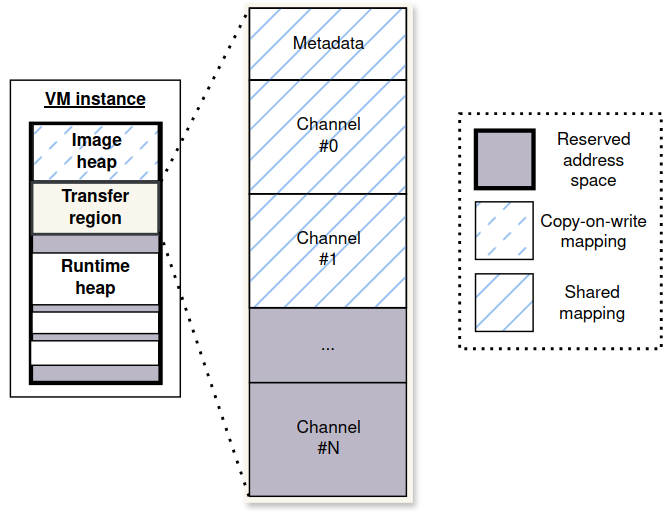
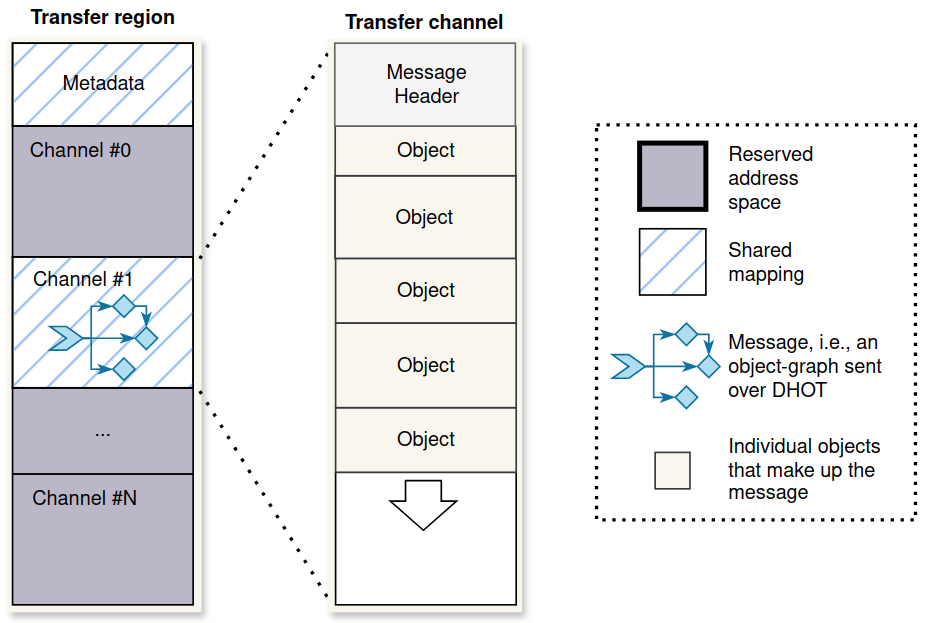
Direct Heap-Object Transfer (DHOT) is specialized for systems that spawn multiple isolated instances of the same (or compatible) language runtime that hosts application execution. It facilitates efficient communication of objects across language-runtime instances in such environments.
Unlike serialization-based approaches, DHOT captures objects without converting them into an intermediate format, so transfers can be made without the cost of serialization. Technologies such as Oracle GraalVM are representative language runtimes where these insights are immediately useful in the context of GraalVM memory isolates that are employed by serverless platforms for directly snapshotting objects from a program’s heap and reusing them across compatible execution environments.
Acknowledgements
DHOT is developed as part of the research collaboration between the Faculty of Mathematics and Oracle LLC. A US Letter Patent involving DHOT (Ristović et al., 2026) is currently in the publication process under the code ORC26170095-US-PSP.
References
- Ivan Ristović, Vojin Jovanović, Milena Vujošević Janičić: Direct Heap Object Transfer Across Language-Runtime Instances. US Letter Patent, ORC26170095-US-PSP, 2026.